
TL;DR: In Georgia, the driver who violated a traffic law, such as running a red light or failing to yield the right-of-way, is generally found at fault in a T-bone accident. However, Georgia follows a modified comparative negligence rule. This means if you are also found partially responsible for the collision, your potential compensation is reduced by your percentage of fault. If you are determined to be 50% or more at fault, you are barred from recovering any damages at all.
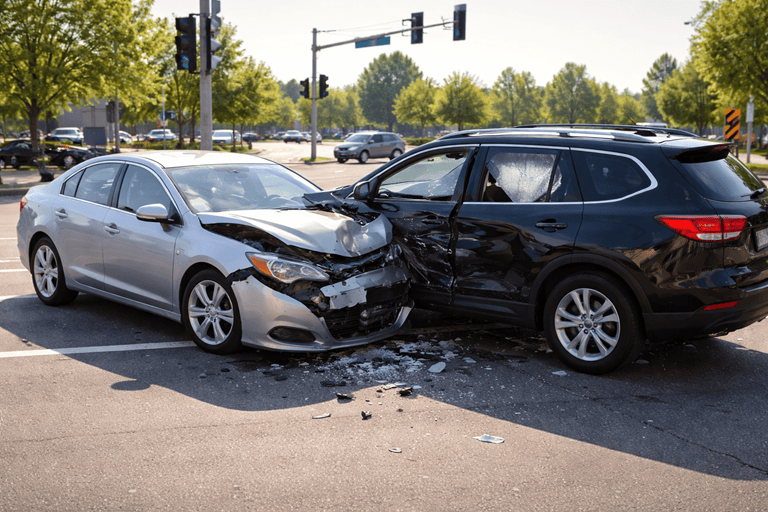
T-bone collisions, also known as side-impact or broadside crashes, are among the most dangerous types of traffic incidents. According to the Insurance Institute for Highway Safety (IIHS), these accidents accounted for 23% of passenger vehicle occupant deaths in a recent year. In Georgia, many of these serious crashes occur at intersections, where one vehicle strikes the side of another, forming a “T” shape. The point of impact often leaves occupants with little protection, leading to severe injuries. Understanding how liability is assigned in these situations is critical for anyone involved.
Georgia operates under an “at-fault” insurance system, which means the person responsible for causing the accident is also responsible for the damages. The state’s legal framework for determining this responsibility is detailed in O.C.G.A. § 51-12-33, the modified comparative negligence statute. This law dictates how fault is apportioned when more than one party may have contributed to the incident. For victims of a T-bone crash, this means establishing the other driver’s fault while minimizing their own is the key to a successful injury claim.
The Presumption of Fault in Side-Impact Collisions
In most T-bone accidents, there is a strong initial presumption that the driver of the striking vehicle is at fault. This assumption is rooted in the fundamental traffic laws governing right-of-way. When one car hits the side of another, it almost always means the driver of the front-striking vehicle violated a traffic rule designed to prevent such a collision. The driver of the struck vehicle typically had the legal right to be where they were at that moment.
This presumption is not automatic proof, but it provides a strong starting point for insurance adjusters and legal professionals. The logic is straightforward: intersections are controlled by signals, signs, and established rules. A driver proceeding legally through an intersection should not be struck on their side by another vehicle. Therefore, the impact itself suggests a failure on the part of the other driver to obey a traffic control device or yield the right-of-way.
Common Scenarios of Clear Liability
Certain situations create a very clear picture of fault. In these cases, the evidence often points directly to one driver’s error, making it difficult for them to dispute liability.
- Running a Red Light or Stop Sign: This is the most common cause of T-bone accidents. A driver who ignores a red light or fails to come to a complete stop at a stop sign and proceeds into the intersection is clearly violating traffic law.
- Failure to Yield on a Left Turn: A driver turning left at an intersection must yield to oncoming traffic. If they misjudge the speed or distance of an approaching vehicle and turn into its path, they are typically held responsible for the resulting collision.
- Ignoring a Yield Sign: Drivers approaching a yield sign must slow down and give the right-of-way to any traffic on the intersecting road. Proceeding without ensuring the way is clear is a direct violation.
The Importance of Right-of-Way Laws
Georgia’s right-of-way laws are the foundation for determining fault in intersection accidents. For example, O.C.G.A. § 40-6-71 states that a driver turning left must yield to any vehicle approaching from the opposite direction. Similarly, O.C.G.A. § 40-6-72 requires drivers to stop at stop signs and yield to traffic on the through street.
When a driver violates one of these safety statutes and causes an accident, it can be classified as negligence per se. This is a legal doctrine meaning the act is considered negligent simply because it violates a law designed to protect public safety. Proving negligence per se strengthens a claim significantly, as it establishes a clear breach of the duty of care owed to other drivers.
How Georgia’s Modified Comparative Negligence Rule Works
While the striking driver is often at fault, liability is not always a 100-0 split. Georgia’s modified comparative negligence rule, found in O.C.G.A. § 51-12-33, allows fault to be shared between the parties involved. This system acknowledges that sometimes, more than one person’s actions contribute to an accident. The rule directly impacts how much compensation, if any, an injured person can receive.
Under this statute, a judge or jury will assign a percentage of fault to each driver based on the evidence. This percentage then determines the financial outcome of the claim. For instance, if you are found to be 20% at fault for the accident, any compensation you are awarded will be reduced by 20%. If your total damages were $100,000, you would only be able to recover $80,000.
The 50% Bar to Recovery
The most critical part of Georgia’s law is the “50% bar.” This rule states that if you are found to be 50% or more responsible for the accident, you are completely barred from recovering any damages from the other driver. This makes the assignment of fault incredibly important. Even being held 49% responsible allows you to recover a portion of your damages, but crossing that 50% threshold eliminates your right to compensation entirely.
Scenario Example:
- Driver A is making a left turn and is struck by Driver B, who was traveling straight through the intersection.
- Evidence shows Driver B was speeding, traveling 15 mph over the limit.
- A jury determines that Driver A was 70% at fault for failing to yield, but Driver B was 30% at fault for speeding, which reduced their ability to avoid the crash.
- Outcome: Driver B can recover 70% of their damages from Driver A’s insurance. Driver A, being more than 50% at fault, recovers nothing.
How Juries and Insurance Adjusters Assign Percentages
Assigning a percentage of fault is a subjective process based on the specific facts and evidence of the case. There is no mathematical formula. Insurance adjusters, and later a jury if the case goes to trial, will consider all contributing factors. These include:
- Traffic law violations: Who had the right-of-way?
- Speed: Was either driver exceeding the speed limit?
- Distraction: Was there evidence of cell phone use or other distractions?
- Visibility: Were weather conditions or obstructions a factor?
- Driver testimony: How do the accounts of each driver compare?
- Witness credibility: Are there independent witnesses to support one version of events?
Because of the 50% bar, insurance companies for the at-fault driver will aggressively look for any evidence that suggests you share some of the blame. Their goal is to push your percentage of fault as high as possible, ideally to 50% or more, to avoid paying the claim.
Challenging the Presumption: When the Struck Vehicle Is at Fault
Although the driver who T-bones another vehicle is usually at fault, this is not always the case. There are specific situations where the driver of the struck vehicle can be held partially or even fully responsible for the collision. Proving these exceptions requires strong evidence, as it goes against the common assumption of liability.
The core principle remains the same: the driver who violated the right-of-way is the one at fault. In some T-bone crashes, the struck vehicle is the one that created the hazard, forcing the other driver into a no-win situation. An experienced investigator or attorney will look for evidence that shifts the focus away from the striking driver and onto the actions of the other party.
Scenarios Where the Struck Driver Shares Blame
Here are some examples where the driver of the vehicle that was hit could be found liable:
- Running a Red Light: If a driver proceeds through a red light and is then struck by a driver who had a green light, the driver who ran the red light is at fault, even though their vehicle was the one that was hit on the side.
- Sudden Entry into Traffic: A driver who pulls out from a driveway, parking lot, or side street directly into the path of an oncoming vehicle can be held liable. They failed to yield the right-of-way to traffic already on the main road.
- Illegal U-Turn: A driver who attempts an illegal or unsafe U-turn and is struck by another vehicle will likely be found at fault for creating the dangerous situation.
- Speeding Through an Intersection: If the struck driver was traveling at an excessive speed, it may have made it impossible for a turning driver to accurately judge the time and space needed to complete their turn safely. In this case, fault could be shared.
- Driving Without Headlights: At night or in poor weather, a driver operating a vehicle without proper headlights may be invisible to other drivers. If a driver pulls into an intersection, believing it to be clear, and strikes an unlit vehicle, the driver of the unlit car could be held partially or fully responsible.
Proving the Other Driver’s Fault
To successfully argue that the struck driver was at fault, you must present compelling evidence that they were the one who acted negligently. This often requires moving beyond the initial police report. An independent investigation may be necessary to uncover facts that were missed at the scene. This could involve finding surveillance footage from a nearby business that shows the struck driver running a stop sign or interviewing witnesses who saw them speeding. This evidence is crucial for overcoming the initial presumption and correctly assigning liability under Georgia’s comparative negligence law.
Essential Evidence Used to Determine Who Is at Fault in a T-Bone Accident in Georgia
The outcome of a T-bone accident claim in Georgia depends entirely on the quality and strength of the evidence. Since the drivers involved often have conflicting stories, objective proof is needed to establish what really happened. A thorough investigation aims to collect and preserve all available evidence to build a clear and convincing narrative of how the crash occurred and who was responsible.
Insurance adjusters and attorneys rely on this evidence to negotiate a settlement. If the case proceeds to court, this same evidence will be presented to a jury to make a final determination of fault. The more comprehensive the evidence, the stronger your position will be.
Key Pieces of Evidence to Collect
Several types of evidence are vital in a side-impact collision case. Each piece helps to paint a more complete picture of the moments leading up to the impact.
- Official Police Report: This is often the first piece of evidence reviewed. It contains the officer’s initial observations, a diagram of the accident scene, statements from drivers and witnesses, and any traffic citations issued. While a citation for a moving violation is powerful evidence of fault, the officer’s opinion is not legally binding.
- Witness Statements: Independent witnesses who have no stake in the outcome are highly credible. Their testimony about what they saw or heard can confirm who had the green light, who was speeding, or whether a driver stopped at a stop sign.
- Photographs and Video Footage: This is some of the most compelling evidence available.
- Scene Photos: Pictures of vehicle positions, skid marks, traffic signals, and property damage can help reconstruct the event.
- Dashcam Video: Footage from either vehicle or from other cars at the scene can provide an indisputable account.
- Surveillance Cameras: Many intersections are monitored by red-light cameras or security cameras from nearby businesses. This footage can definitively show who violated the traffic laws.
- Vehicle Damage Analysis: The location and severity of the damage to both vehicles can tell a story. Accident reconstruction experts can analyze crush patterns, paint transfer, and other physical evidence to estimate speeds, angles of impact, and the sequence of events.
- Event Data Recorder (EDR) Information: Most modern vehicles are equipped with an EDR, or “black box.” This device records data in the seconds before a crash, such as vehicle speed, brake application, steering angle, and throttle position. Accessing this data can provide objective proof of a driver’s actions.
The Role of an Accident Reconstruction Expert
In complex cases where liability is heavily disputed, an accident reconstruction expert may be retained. These professionals are often former law enforcement officers or engineers with specialized training. They use physics, mathematics, and engineering principles to analyze all the available evidence and form a scientific opinion on how the accident happened. Their testimony can be instrumental in proving fault, especially when witness accounts are contradictory or physical evidence is ambiguous. They can create detailed reports, diagrams, and animations to present their findings clearly to an insurance company or a jury.
Common Causes of T-Bone Accidents and Their Impact on Liability
Understanding the root causes of T-bone accidents is key to understanding how liability is assigned. Most of these collisions are not random events; they are the direct result of a driver’s mistake, distraction, or reckless behavior. When these actions violate a specific Georgia traffic law, it provides a direct link between the behavior and legal fault for the crash.
Investigating the “why” behind an accident often uncovers clear evidence of negligence. For example, proving a driver was texting at the time of the crash not only shows they were distracted but also that they violated Georgia’s hands-free law, strengthening the case against them.
Driver Errors and Distractions
The vast majority of side-impact crashes are caused by preventable driver errors. These actions demonstrate a clear disregard for the safety of others on the road.
- Distracted Driving: This is a leading cause of intersection accidents. Under O.C.G.A. § 40-6-241, Georgia’s hands-free law, it is illegal to hold or support a phone while driving. Phone records can often show if a driver was texting, talking, or using an app at the moment of the crash.
- Impaired Driving (DUI): A driver under the influence of alcohol or drugs has impaired judgment, reduced coordination, and slower reaction times. A DUI arrest at the scene of an accident is powerful evidence of gross negligence.
- Aggressive Driving and Speeding: Speeding through an intersection reduces the time a driver has to react to changing signals or other vehicles. It also significantly increases the force of impact, leading to more severe injuries.
- Driver Fatigue: Drowsy driving can be as dangerous as drunk driving. A driver who falls asleep at the wheel or has slowed reaction times due to exhaustion can easily cause a devastating T-bone crash.
Environmental and Vehicle-Related Factors
While less common, sometimes factors beyond the drivers’ control contribute to a T-bone accident. In these situations, liability may extend to third parties.
- Obstructed Views: A stop sign or traffic light obscured by overgrown trees or a poorly placed sign could lead to an accident. In this case, the government entity responsible for maintaining the roadway could be held partially liable.
- Malfunctioning Traffic Signals: If traffic lights are not functioning correctly and show green in both directions, both drivers may believe they have the right-of-way. Liability could fall on the municipality or contractor responsible for the signal’s maintenance.
- Vehicle Defects: A T-bone crash could be caused by a mechanical failure, such as brake failure or a steering system malfunction. If the failure was due to a design or manufacturing defect, the vehicle manufacturer could be held liable through a product liability claim. If it was due to negligent repair work, the mechanic shop could be responsible.
Steps to Take Immediately After a Side-Impact Collision
The actions you take in the minutes and hours following a T-bone accident can have a significant impact on your health and your ability to recover fair compensation. It is a stressful and disorienting experience, but staying as calm as possible and following a clear set of steps can help protect your rights.
Your priority is always safety and medical well-being. However, if you are able, gathering information at the scene is crucial because evidence can disappear quickly. Skid marks fade, witnesses leave, and memories become less reliable over time.
Protecting Your Health and Legal Rights at the Scene
- Check for Injuries and Call 911: Assess yourself and your passengers for injuries. Call 911 immediately to report the crash and request medical assistance and police.
- Move to a Safe Location: If your vehicle is in a dangerous spot and can be moved, pull over to the shoulder. If not, turn on your hazard lights and remain in your vehicle with your seatbelt on until help arrives.
- Do Not Admit Fault: Avoid saying things like “I’m sorry” or “I didn’t see you.” These statements can be interpreted as an admission of guilt by insurance companies, even if you were just being polite. Stick to the facts when speaking with the other driver and the police.
- Exchange Information: Get the other driver’s name, address, phone number, driver’s license number, and insurance information. Also, get the make, model, and license plate number of their vehicle.
- Document the Scene: Use your smartphone to take extensive photos and videos. Capture the damage to both cars from multiple angles, the final resting positions of the vehicles, skid marks, debris on the road, traffic signals, and any relevant road conditions.
- Identify Witnesses: If there are any witnesses, ask for their names and contact information. Their objective account can be invaluable later.
Post-Accident Actions
- Seek Immediate Medical Attention: Even if you feel fine, you should see a doctor. Some serious injuries, like whiplash or internal bleeding, may not have immediate symptoms. This creates a medical record linking your injuries to the accident.
- Report the Accident to Your Insurer: Notify your own insurance company about the crash promptly. Provide them with the basic facts but avoid speculating on fault.
- Consult a Georgia Car Accident Attorney: Before you give a recorded statement to the other driver’s insurance company, it is wise to speak with an attorney. The other insurer’s goal is to minimize their payout, and they may try to get you to say something that hurts your claim. A Georgia car accident attorney can advise you on how to proceed and handle all communications on your behalf.
How a Georgia Car Accident Attorney Investigates Fault
When liability in a T-bone accident is disputed, or the injuries are severe, the assistance of a skilled Georgia car accident attorney can be essential. While you focus on your physical recovery, your attorney can launch a comprehensive investigation to establish fault and build a strong case for compensation. Their role is to level the playing field against large insurance companies that have teams of adjusters and lawyers working to protect their bottom line.
An attorney’s investigation goes far beyond the initial police report. They have the resources and legal knowledge to uncover evidence that may not be immediately obvious. This proactive approach is designed to counter any attempts by the other side to shift blame and to ensure your claim is supported by a solid foundation of facts.
Building a Strong Case for Your Claim
An attorney methodically pieces together the events of the crash to create a clear and persuasive argument for why the other driver is liable. This process typically involves several key steps:
- Preserving Evidence: The first step is often to send a spoliation letter to the other driver and their insurer. This is a legal notice demanding that they preserve crucial evidence, such as the vehicle itself and its event data recorder (EDR), so it can be inspected.
- Independent Investigation: Your legal team will visit the accident scene, take measurements, and look for evidence the police may have missed, such as surveillance cameras from nearby businesses.
- Hiring Experts: For complex cases, an attorney will retain accident reconstruction experts to analyze the physical evidence and provide a scientific opinion on fault. They may also work with medical experts to document the full extent of your injuries and future medical needs.
- Interviewing Witnesses: Your attorney will contact any known witnesses to get detailed statements while their memories are still fresh. They may also canvass the area to find other potential witnesses who were not identified in the police report.
- Handling Insurance Communications: Your t-bone accident attorney will manage all communication with the insurance companies. This prevents you from inadvertently saying something that could be used against you and allows them to present your claim in the most effective way possible, backed by the evidence they have gathered.
Case Study Example
A driver was T-boned at a four-way stop. The other driver claimed our client ran the stop sign. The police report was inconclusive, listing conflicting statements. The other driver’s insurance company denied the claim, placing 100% of the fault on our client. Our firm’s investigation uncovered a doorbell camera from a home a block away. The footage, though distant, was clear enough to show the other driver’s vehicle speeding and failing to slow down for the intersection, while our client’s vehicle came to a complete stop before proceeding. Presented with this undeniable evidence, the insurance company reversed its decision and offered a full policy-limits settlement.
Conclusion
Determining who is at fault in a T-bone accident in Georgia involves more than just identifying which car struck the other. While the driver who failed to yield the right-of-way is typically held responsible, Georgia’s modified comparative negligence law complicates matters. This rule allows for shared fault, and if an injured party is found to be 50% or more responsible, they are prevented from recovering any compensation. This makes the collection and presentation of evidence absolutely critical to the success of a personal injury claim.
If you have been injured in a side-impact collision, taking swift and decisive action is essential to protect your rights. The evidence needed to prove your case can disappear quickly, and insurance companies will begin their own investigation immediately. Do not provide a recorded statement or accept a settlement offer without fully understanding your legal position. Consulting with a qualified Georgia personal injury attorney can provide you with the clarity and guidance needed to make informed decisions. An experienced lawyer can investigate the crash, establish liability, and fight to ensure you receive the full compensation you deserve for your injuries and losses. Contact us today for free case evaluation.