
TL;DR: In a T-bone accident, the driver who violated the right-of-way is almost always considered at fault. This typically means the person who ran a red light, ignored a stop sign, or made an unsafe left turn into oncoming traffic is legally responsible for the collision. However, fault can sometimes be shared. If the driver with the right-of-way was speeding, distracted, or otherwise driving recklessly, they may be found partially liable under a state’s comparative negligence laws.
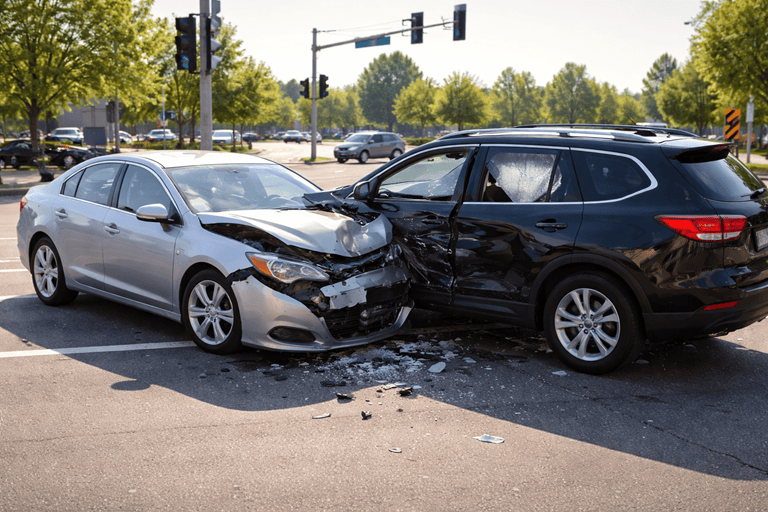
T-bone collisions, also known as side-impact or broadside crashes, represent one of the most dangerous types of traffic incidents. According to the Insurance Institute for Highway Safety (IIHS), angle collisions accounted for approximately 19% of all passenger vehicle occupant deaths in a recent year. These accidents most frequently occur at intersections, where the paths of two or more vehicles are meant to cross in an orderly fashion. When that order breaks down due to a driver’s error, the front of one vehicle strikes the side of another, creating the characteristic “T” shape and often resulting in severe injuries.
The entire framework of traffic law is built on the concept of right-of-way, a set of rules dictating which vehicle must yield to another to ensure a safe and predictable flow of traffic. In nearly every T-bone accident, the central legal question is which driver had the right-of-way and which driver failed to yield it. Determining fault is not just about identifying the striking vehicle; it is about pinpointing the specific action or inaction that violated a traffic law and directly caused the crash. Understanding these rules is the first step toward establishing liability and seeking compensation for damages and injuries.
The Presumption of Fault: Understanding Right-of-Way Violations
In most side-impact collisions, there is a strong legal presumption that one driver is primarily at fault. This presumption is tied directly to the violation of right-of-way rules. Unlike a rear-end collision where the rear driver is almost always liable, in a T-bone crash, the driver who was struck often had the legal right to be where they were. The fault typically lies with the driver whose vehicle created the hazard by improperly entering an intersection or a lane of traffic.
This principle is the foundation of any T-bone accident claim. Insurance adjusters and legal professionals begin their investigation by looking for clear evidence of a right-of-way violation. The driver who commits this violation is considered negligent because they have breached their duty to operate their vehicle safely and in accordance with traffic laws.
Running Red Lights and Stop Signs
The most straightforward T-bone accident scenario involves a driver disregarding a traffic control device. A driver who proceeds through a solid red light or fails to stop at a stop sign enters the path of cross-traffic that has a green light or a clear right-of-way. When this happens, a collision is almost inevitable.
Proving this violation is often a matter of collecting direct evidence. A police report may include a citation issued to the driver who ran the light or sign. Statements from independent witnesses who saw the signal’s color or the driver’s failure to stop are incredibly powerful. Furthermore, many urban and suburban intersections are equipped with traffic cameras or surveillance cameras from nearby businesses, which can provide indisputable video proof of the violation.
Failure to Yield on Left Turns
Another frequent cause of T-bone crashes is an improper left turn. A driver making an unprotected left turn (a turn at a green light without a dedicated green arrow) has a legal duty to yield to all oncoming traffic. The driver must wait for a safe gap before proceeding. Many drivers misjudge the speed of oncoming vehicles or become impatient and turn into the path of a car that is lawfully proceeding straight through the intersection.
In these cases, the driver turning left is almost always found to be at fault. The law is clear: the responsibility to ensure the turn is safe rests entirely on the turning driver. The driver going straight has the right-of-way and is not expected to slow down or stop to allow another car to turn in front of them.
Entering Traffic from a Driveway or Side Road
The duty to yield also applies to vehicles entering a roadway from a private driveway, a parking lot, or a smaller side street. The driver on the main thoroughfare has the right-of-way. The entering driver must wait until the way is clear before merging into traffic. If that driver pulls out in front of an oncoming car and is T-boned, the entering driver is typically held responsible for causing the crash. This rule ensures the smooth and safe flow of traffic on main roads, placing the burden of caution on those seeking to join it.
When the Striking Driver Shares Fault: Comparative Negligence Explained
While the driver who violates the right-of-way is usually the primary at-fault party, liability is not always an all-or-nothing proposition. Many states follow a legal doctrine known as comparative negligence. This system allows fault to be divided between multiple parties based on their degree of responsibility for the accident. If the driver who had the right-of-way was also acting negligently, their compensation could be reduced, or in some states, barred entirely.
For example, if a jury determines the victim was 20% at fault for the accident, their final compensation award would be reduced by 20%. This makes it critical for insurance companies and t-bone accident attorneys to investigate the actions of both drivers, not just the one who made the initial error. A driver with the right-of-way is not given a free pass to drive recklessly.
The Role of Excessive Speed
Speeding is one of the most common factors that can lead to shared fault. A driver proceeding through a green light has the right-of-way, but they also have a duty to travel at a safe and legal speed. If they are traveling significantly over the speed limit, their actions can contribute to the crash in two key ways. First, their excessive speed makes it much harder for the turning or entering driver to accurately judge the time they have to proceed safely. Second, the higher speed reduces the driver’s own ability to react and potentially brake or swerve to avoid a collision.
Scenario Example: A driver stops at a stop sign and looks both ways. They see a car approaching from the left but believe it is far enough away to proceed safely. However, that car is traveling 55 mph in a 35 mph zone. The first driver pulls into the intersection and is T-boned. While the driver who ran the stop sign is primarily at fault, the speeding driver could be assigned a percentage of liability because their unlawful speed was a contributing factor to the collision.
Distracted Driving and Inattention
Another factor is driver inattention. All drivers have a general duty to be aware of their surroundings and avoid hazards when possible. If the driver with the right-of-way was texting, talking on a handheld cell phone, or otherwise distracted, they may not have noticed the other vehicle entering their path in time to take evasive action.
Proving distraction can be more difficult but is not impossible. Cell phone records can be subpoenaed in a lawsuit to show if the driver was using their phone at the moment of the crash. Witness statements might also indicate that the driver was looking down or not paying attention to the road. Even with the right-of-way, a failure to exercise reasonable care can result in shared fault.
Driving Under the Influence (DUI)
If the driver who was struck was operating their vehicle under the influence of alcohol or drugs, this can also introduce shared liability. Impairment slows reaction time, affects judgment, and can reduce a driver’s ability to respond to a dangerous situation. An insurance company or defense attorney will argue that even if their client ran the red light, a sober driver would have been able to brake or swerve to lessen the impact or avoid it completely.
Essential Evidence for Proving Liability in a Side-Impact Crash
Determining who is at fault in a T-bone accident is not based on assumptions; it is based on evidence. Immediately after a crash, the process of gathering and preserving this evidence begins. The strength of a personal injury or property damage claim hinges on the quality and clarity of the proof presented to the insurance companies or, if necessary, to a court. A successful claim requires a detailed and factual account of the moments leading up to the collision.
Without compelling evidence, even a seemingly clear-cut case can become a difficult “he said, she said” dispute. The other driver may change their story, or their insurance company may look for any ambiguity to deny or reduce the claim. This is why a proactive approach to evidence collection is so important.
The Official Police Report
When law enforcement responds to an accident scene, the responding officer creates an official police report. This document is one of the most critical pieces of initial evidence. It typically contains:
- A diagram of the accident scene, showing the final resting positions of the vehicles.
- Statements from both drivers and any witnesses.
- The officer’s professional opinion on how the crash occurred and who may have been at fault.
- Information on any traffic citations issued at the scene (e.g., a ticket for running a stop sign).
While the officer’s opinion on fault is not legally binding in court, it carries significant weight with insurance adjusters. Obtaining a copy of this report is a crucial first step.
Witness Statements and Testimony
Independent witnesses are invaluable. A neutral third party with no stake in the outcome who can confirm that one driver ran a red light or pulled out unsafely provides highly credible evidence. It is essential to get the names and contact information of anyone who saw the accident before they leave the scene. A personal injury attorney can later contact these witnesses to get a formal statement about what they observed. Their testimony can be the deciding factor when a driver’s account is disputed.
Photographic and Video Evidence
In the modern era, visual evidence is king. Using a smartphone to document the scene can provide a wealth of information. Important photos to take include:
- Vehicle Damage: Close-up photos of the damage to both cars and wider shots showing their positions relative to each other. The location of the impact is key in a T-bone case.
- The Scene: Pictures of the entire intersection, including traffic signals, stop signs, road markings, and any visual obstructions.
- Skid Marks and Debris: These can help accident reconstruction experts determine vehicle speeds and the point of impact.
Beyond personal photos, video footage from dashcams or nearby surveillance systems (from businesses, homes, or municipal traffic cameras) can provide an unbiased view of the collision as it happened. A car accident attorney can send a formal preservation letter to a business to ensure this crucial footage is not erased.
How Vehicle Damage and Crash Physics Help Determine Fault
Sometimes, driver and witness statements conflict. In these situations, the physical evidence left behind at the scene and on the vehicles themselves can tell the true story. The principles of physics and engineering do not lie. Trained professionals, known as accident reconstructionists, can analyze this physical evidence to scientifically determine how a T-bone crash occurred, often with a high degree of certainty.
This type of expert analysis is especially important in cases involving serious injuries or disputed liability. It moves the argument away from subjective accounts and toward objective, data-driven conclusions. Insurance companies often employ their own experts, which is why having an independent expert can be vital for protecting your interests.
Location and Severity of Damage
The physical damage to the vehicles provides immediate clues. In a classic T-bone, the front of one car shows crush damage, while the side of the other car is caved in. The exact location of the side impact (e.g., on the front quarter panel, the driver’s door, or the rear passenger door) can help establish the timing of the collision. For example, an impact on the rear of the car might suggest the struck vehicle had almost cleared the intersection, which could be relevant in a dispute over a yellow light. The severity of the damage can also be used in calculations to estimate the speed of the striking vehicle.
Accident Reconstruction Experts
Accident reconstruction is a specialized field that uses scientific principles to investigate motor vehicle collisions. An expert will visit the crash scene to take precise measurements of skid marks, debris fields, and road geometry. They will then combine this information with:
- An analysis of the vehicle damage.
- The vehicle’s specifications (weight, size, braking capabilities).
- Data from the vehicle’s “black box.”
Using this data, they can calculate factors like pre-impact and post-impact speeds, the angle of impact, and the sequence of events. Their findings are often presented in a detailed report with diagrams and animations that can clearly demonstrate to an insurance adjuster or a jury exactly how the accident unfolded and which driver was negligent.
Event Data Recorders (EDRs)
Most modern vehicles are equipped with an Event Data Recorder (EDR), often called a “black box.” This device records and stores technical data for a few seconds immediately before, during, and after a crash. The data can include:
- Vehicle speed
- Brake application
- Throttle position
- Steering wheel angle
- Seatbelt usage
Accessing EDR data requires specialized equipment and expertise. This information can be incredibly powerful. For instance, if a driver claims they were braking before the impact, the EDR data can confirm or refute that statement. It provides an unbiased, second-by-second account of a vehicle’s operation, cutting through conflicting stories to reveal the facts.
Common T-Bone Scenarios and Who Is Typically at Fault
While the general principle of right-of-way applies to all T-bone accidents, understanding how it works in specific, common situations can help clarify who is likely to be held responsible. Intersections, parking lots, and turning lanes all have their own unique dynamics and rules that govern driver behavior.
Scenario 1: The Four-Way Stop
At an intersection with stop signs in all four directions, the rules are well-established. The first vehicle to arrive at the intersection has the right-of-way to proceed first. If two vehicles arrive at the same time, the vehicle on the right has the right-of-way. A T-bone crash at a four-way stop almost always means one driver either failed to stop completely or proceeded out of turn. Fault is assigned to the driver who violated this sequence.
Scenario 2: The Unprotected Left Turn
This is one of the most common causes of serious T-bone collisions. A driver waiting to turn left at a standard green light must yield to all oncoming traffic. The driver proceeding straight through the intersection has the absolute right-of-way. If the turning driver misjudges the speed or distance of an oncoming car and gets T-boned, the turning driver is nearly always found 100% at fault for failure to yield. The only potential exception is if the straight-traveling driver was excessively speeding or ran a red light.
Scenario 3: The Parking Lot Collision
Parking lots can be chaotic, as formal traffic laws are not always strictly applied. However, general right-of-way principles still exist. A vehicle traveling in a main thoroughfare lane within the parking lot has the right-of-way over a vehicle pulling out of a parking space. If a driver backs out or pulls forward from a spot and is struck by a car in the travel lane, the driver exiting the space is usually at fault. They have the greater duty to ensure the lane is clear before entering it.
Scenario 4: Malfunctioning Traffic Lights
In the rare event that a T-bone crash occurs because traffic signals are malfunctioning (e.g., showing green in all directions), determining fault becomes much more complex. In this situation, the intersection should be treated as a four-way stop. Drivers have a duty to proceed with caution when a signal is clearly not working correctly. Liability could potentially be shared between the drivers if neither exercised sufficient care. Additionally, a claim might be brought against the government entity (city or state) responsible for maintaining the traffic signals, though these cases can be difficult to win due to governmental immunity rules.
The Role of Insurance Companies and Legal Counsel
After a T-bone accident, you will almost certainly be dealing with at least one insurance company. It is crucial to remember that an insurance adjuster, even one from your own provider, is not a neutral party. Their primary objective is to resolve the claim for the lowest possible cost to their company. This means they will conduct their own investigation with the goal of minimizing or denying your claim.
Understanding their role and knowing when to seek professional legal help can make a significant difference in the outcome of your case, especially if you have sustained serious injuries.
How Insurance Adjusters Investigate
The other driver’s insurance adjuster will likely contact you soon after the accident. They will investigate by reviewing the police report, speaking with witnesses, and examining photos of the damage. Their goal is to find any evidence that suggests you were partially at fault. They may ask leading questions or try to get you to admit to something that could hurt your claim. For example, they might ask, “You were in a hurry, weren’t you?” or “Were you looking at your phone?” They are trained to find inconsistencies in your story and look for reasons to assign you a percentage of blame under comparative negligence rules.
Why You Shouldn’t Give a Recorded Statement Alone
One of the first things an adjuster will ask for is a recorded statement about the accident. You are not legally obligated to provide one to the other driver’s insurance company. It is highly advisable to decline this request until you have spoken with a personal injury attorney. Adjusters use recorded statements to lock you into a specific version of events and will scrutinize every word to find something they can use against you later. An attorney can help you prepare a statement or can handle all communications with the insurance company on your behalf, ensuring your rights are protected.
When to Contact a Personal Injury Attorney
You should consider contacting an attorney in any of the following situations:
- You or a passenger were injured.
- Liability is being disputed by the other driver or their insurer.
- The insurance company is delaying your claim or has made a lowball settlement offer.
- The evidence is complex and may require an accident reconstruction expert.
An experienced car accident attorney works for you. They can launch an independent investigation, hire experts, gather all necessary evidence, and negotiate with the insurance company from a position of strength. They understand the tactics adjusters use and can build a compelling case to demonstrate the other driver’s full liability and the true value of your damages. Contact us today for free case evaluation.
Conclusion
In a T-bone accident, the question of fault almost always comes down to which driver failed to yield the right-of-way. The driver who runs a stop sign, ignores a red light, or makes an unsafe turn is typically held responsible. However, the legal doctrine of comparative negligence means that liability can be shared if the other driver contributed to the crash through actions like speeding or distracted driving. Proving fault requires a thorough investigation supported by solid evidence, including police reports, witness statements, video footage, and sometimes expert analysis of the crash physics.
Because the financial stakes can be high, insurance companies will work diligently to minimize their payout by shifting blame. It is essential to act quickly to preserve evidence and protect your legal rights. Do not assume that a seemingly straightforward case will be handled fairly without proper advocacy. If you have been injured in a side-impact collision, consulting with a qualified personal injury attorney is the most effective step you can take. An attorney can manage the complexities of your claim, counter the insurance company’s tactics, and fight to secure the full and fair compensation you deserve for your medical bills, lost wages, and other damages. Get in touch with our attorneys today for free case evaluation.