
TL;DR: In Georgia, the driver who hits a vehicle from behind is almost always presumed to be at fault. This is based on the legal duty for all drivers to maintain a safe following distance. However, this presumption is not absolute. The lead driver can be found partially or fully at fault if they were negligent, such as by braking suddenly for no reason, having non-working brake lights, or making an unsafe lane change. Georgia’s modified comparative negligence rule means that if the lead driver is found to be 50% or more at fault, they cannot recover any damages.
Jump to a section
- The Presumption of Fault in Georgia Rear-End Collisions
- Common Exceptions to the Rear-End Fault Presumption in Georgia
- Georgia’s Modified Comparative Negligence Rule
- The Role of Evidence in Determining Fault
- How Insurance Companies Investigate Rear-End Claims
- Specific Scenarios: Multi-Car Pileups and Chain Reactions
- Conclusion
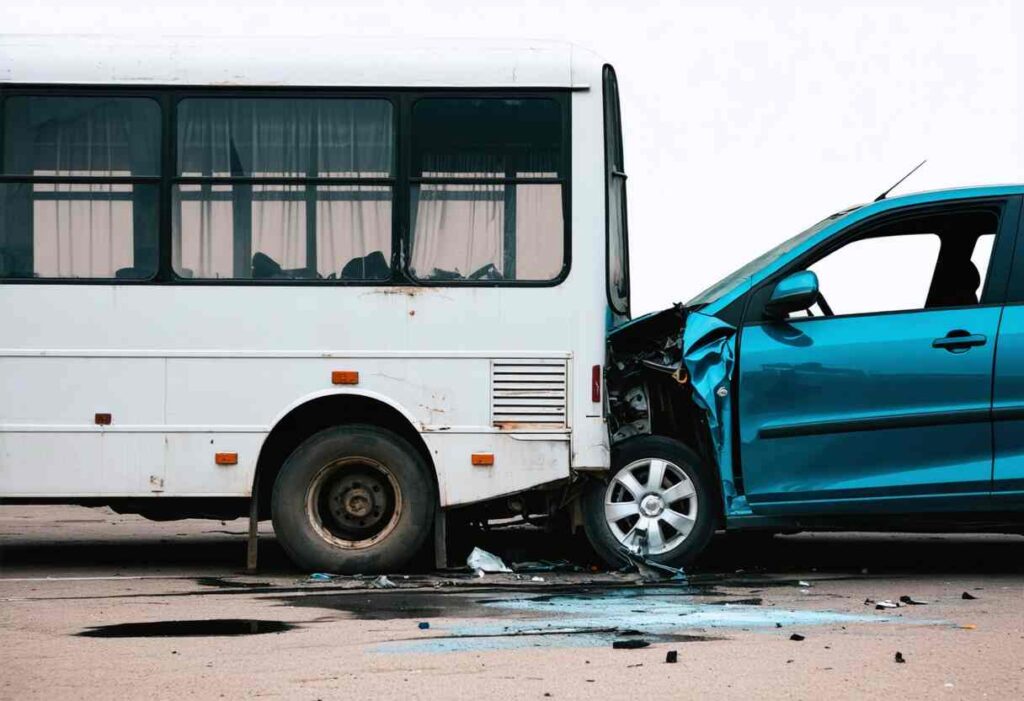
Rear-end collisions are a frequent occurrence on Georgia’s busy roads, from the dense traffic of I-285 in Atlanta to the rural highways connecting smaller towns. According to the Georgia Department of Transportation, these types of crashes consistently rank among the most common, often resulting from driver inattention, following too closely, or speeding. While many assume these incidents are straightforward, determining legal responsibility involves more than just identifying which car was in front.
The legal framework in Georgia provides a clear starting point for assigning liability in these cases. Official Code of Georgia Annotated (O.C.G.A.) § 40-6-49, often referred to as the “following too closely” statute, is central to these determinations. This law states that a driver shall not follow another vehicle more closely than is “reasonable and prudent,” considering the speed of the vehicles, traffic, and road conditions. This statute creates a strong legal assumption that the rear driver is at fault, but it doesn’t automatically close the case. Understanding the exceptions and how fault can be shared is crucial for anyone involved in such an accident.
The Presumption of Fault in Georgia Rear-End Collisions
In Georgia, the legal system operates on a clear principle when it comes to rear-end accidents: there is a strong presumption that the trailing driver is at fault. This isn’t just a common belief; it’s a legal doctrine rooted in established traffic laws and the fundamental duties of every driver. The core of this presumption lies in the responsibility of every motorist to control their vehicle and maintain a safe distance from the car ahead. This duty ensures they have enough time and space to react to sudden stops or changes in traffic flow.
The legal basis for this is O.C.G.A. § 40-6-49. This law explicitly requires drivers to keep a “reasonable and prudent” distance from the vehicle in front of them. What is considered “reasonable and prudent” is not defined by a specific number of car lengths but is a flexible standard that depends on the circumstances. Factors like weather conditions (rain, fog), road conditions (wet pavement, construction zones), visibility, and the prevailing speed of traffic all influence what a safe following distance should be. A driver who fails to adjust their following distance for these factors and subsequently collides with the vehicle in front is typically seen as having breached their duty of care.
This presumption simplifies the initial assessment of liability for law enforcement and insurance companies. When an officer arrives at the scene of a rear-end crash, their report will often cite the rear driver for following too closely. Similarly, an insurance adjuster will begin their investigation with the assumption that their insured (if they were the trailing driver) is liable for the damages.
Understanding the “Rebuttable Presumption”
It is critical to understand that this is a rebuttable presumption, not an absolute rule. “Rebuttable” means that the assumption of fault can be challenged and overturned with sufficient evidence. The burden of proof shifts to the trailing driver to demonstrate that the lead driver’s actions, or some other factor, caused or contributed to the collision. Simply stating that the car in front “stopped for no reason” is rarely enough. The rear driver must provide concrete evidence to support their claim. This evidence could include witness testimony, dashcam footage, or physical evidence from the scene that contradicts the initial assumption. Successfully rebutting the presumption requires a clear and convincing argument that the lead driver acted in a negligent or unpredictable manner, making the collision unavoidable for a reasonably prudent driver.
Common Exceptions to the Rear-End Fault Presumption in Georgia
While the trailing driver is usually held responsible, there are several recognized situations where the lead driver can share or even bear the majority of the fault. These exceptions hinge on the idea that all drivers, including the one in front, have a duty to operate their vehicles safely and predictably. When a lead driver’s negligence creates a sudden hazard, the presumption of fault against the rear driver can be weakened or completely overcome.
Sudden and Unnecessary Braking
One of the most common arguments made by a trailing driver is that the lead driver slammed on their brakes for no apparent reason. This is more than just a quick stop for a yellow light or a pedestrian. To be considered a valid exception, the braking must be both sudden and without a justifiable cause. For example, if a driver brakes aggressively in an act of “road rage” or stops abruptly in the middle of a highway with no obstacle ahead, they could be found negligent. Proving this can be difficult and often requires an independent witness or video evidence, as it otherwise becomes a “he said, she said” situation.
Malfunctioning or Inoperative Brake Lights
Every vehicle is legally required to have functioning brake lights. These lights are a critical safety feature that signals a driver’s intention to slow down or stop. If a lead vehicle’s brake lights are broken or so dirty that they are not visible, the trailing driver may not receive adequate warning to react in time. In this scenario, the lead driver’s failure to maintain their vehicle in safe working order constitutes negligence. An investigation might involve examining the vehicle’s bulbs and wiring or looking for mentions of non-functional equipment in the police report.
Unsafe Lane Changes or Merging
A rear-end collision isn’t always a straightforward case of one car following another in the same lane. Fault can shift if the lead driver makes an unsafe or illegal maneuver immediately before the impact. This includes:
- Cutting someone off: A driver who changes lanes abruptly without enough space, forcing the car behind them to brake suddenly.
- Improper merging: Merging onto a highway at a speed significantly slower than the flow of traffic or without yielding the right-of-way.
- Illegal U-turn: Attempting a U-turn in a location where it is prohibited or without ensuring the way is clear.
In these cases, the collision is a direct result of the lead driver’s unpredictable action, not the trailing driver’s inability to stop in time under normal conditions.
Reversing or Stopping Illegally
A lead driver who unexpectedly puts their vehicle in reverse on a public road or stops in a travel lane where it is prohibited (e.g., on a highway overpass or in a “no stopping” zone) can be held liable. These actions create a hazard that other drivers would not reasonably anticipate. For instance, if a driver misses their turn and suddenly stops and begins to reverse in a lane of moving traffic, they are creating an extremely dangerous situation. Any resulting collision would likely be attributed to their negligent and illegal maneuver.
Georgia’s Modified Comparative Negligence Rule
Understanding fault in a Georgia car accident requires looking beyond who was “right” and who was “wrong.” The state follows a legal doctrine known as modified comparative negligence, which is codified in O.C.G.A. § 51-12-33. This rule acknowledges that very few accidents are 100% the fault of a single person. More often, multiple parties contribute to an incident through their actions or inactions. The comparative negligence system provides a way to assign a percentage of fault to each party involved and distribute financial responsibility accordingly.
Under this system, a person injured in an accident can still recover damages even if they were partially to blame. However, their total compensation award will be reduced by their percentage of fault. For example, if you are deemed to be 20% at fault for a rear-end collision and your total damages are calculated at $50,000, your final recovery would be reduced by 20% ($10,000), leaving you with a $40,000 settlement. This allows for a more equitable outcome than an “all-or-nothing” system, where being even 1% at fault could prevent you from recovering anything.
This rule is particularly relevant in rear-end collisions where the lead driver’s behavior may have contributed to the crash. For instance, a jury might find that the trailing driver was 70% at fault for following too closely, but the lead driver was 30% at fault for having a broken brake light. In this case, the lead driver could still recover 70% of their total damages from the trailing driver’s insurance.
The 50% Bar to Recovery
The “modified” aspect of Georgia’s rule is a critical threshold: the 50% bar. This rule states that an individual cannot recover any damages if they are found to be 50% or more at fault for the accident. If a jury or insurance company determines your fault is 49% or less, you can recover a reduced amount. But if your fault is determined to be 50% or greater, you are legally barred from receiving any compensation from the other party.
This makes the assignment of fault percentages incredibly important. Insurance adjusters are well aware of this rule and may try to shift blame to push a claimant over the 49% threshold, thereby eliminating their company’s liability. For example, they might argue that your sudden stop, combined with your delayed use of a turn signal, makes you equally responsible as the driver who was texting and hit you. This is why gathering strong evidence to minimize your assigned percentage of fault is essential for protecting your right to compensation. The difference between being 49% at fault and 50% at fault is the difference between receiving a partial recovery and receiving nothing at all.
The Role of Evidence in Determining Fault
Because fault in a rear-end collision is not always automatic, the evidence collected from the scene and afterward is what ultimately proves liability. The initial presumption against the rear driver is just a starting point. A strong collection of evidence can either solidify that presumption or successfully challenge it. Without compelling proof, determining percentages of fault under Georgia’s comparative negligence rule becomes a matter of one driver’s word against the other’s, which often works in the insurance company’s favor.
The first and often most important piece of evidence is the official police report. When law enforcement responds to an accident, the officer will document their observations, diagram the scene, note the location of vehicle damage, and take statements from drivers and witnesses. The officer may also issue a traffic citation to one of the drivers, typically for following too closely (O.C.G.A. § 40-6-49) or another violation. While a citation is not definitive proof of fault in a civil claim, it is powerful evidence that insurance companies and juries take very seriously.
Photographs and videos taken at the scene are also invaluable. Using your smartphone to document everything can preserve crucial details. Be sure to capture:
- Vehicle positions: Show where the cars came to rest after the impact.
- Damage to both vehicles: Close-up shots of the damage can help accident reconstruction experts understand the force and angle of the collision.
- Skid marks: The length and direction of skid marks can indicate braking patterns and vehicle speeds.
- Road conditions: Document any hazards, construction, or poor weather conditions.
- Surrounding area: Capture traffic signals, signs, and any visual obstructions.
Preserving Digital Evidence
In the modern era, digital evidence plays an increasingly significant role. Dashcam footage from your vehicle, a witness’s vehicle, or a nearby commercial truck can provide an unbiased account of the moments leading up to the crash. This type of evidence can instantly resolve disputes over who changed lanes, who braked suddenly, or whether a brake light was working. Additionally, many intersections and businesses have surveillance cameras. It is important to act quickly to request and preserve this footage, as many systems automatically overwrite recordings after a short period. A rear end collision attorney can send a formal spoliation letter to a business or government entity to ensure they do not delete relevant video evidence.
The Importance of a Medical Evaluation
Seeking a prompt medical evaluation after any collision is crucial for two reasons. First, it protects your health. Injuries like whiplash or concussions may not show immediate symptoms, and a medical professional can identify and begin treating them. Second, it creates an official record linking your injuries to the accident. A delay in seeking treatment can give an insurance company an opening to argue that your injuries were not caused by the crash or are not as severe as you claim. Your medical records become a cornerstone of your injury claim, documenting the extent of your physical harm and the cost of your recovery.
How Insurance Companies Investigate Rear-End Claims
After a rear-end collision is reported, the insurance companies for both drivers will launch their own investigations to determine liability. Their goal is not necessarily to find the objective truth but to minimize their own financial exposure. The adjuster for the at-fault driver’s insurance company will be looking for any evidence that allows them to shift blame, reduce the value of a claim, or deny it altogether. Understanding their process and tactics is key to protecting your interests.
The investigation begins when a claim is filed. The assigned insurance adjuster will start by gathering basic information, including the police report, photos from the scene, and contact information for everyone involved. They will then request a recorded statement from their own insured driver and will likely try to get one from you as well. It is important to be cautious when speaking to the other driver’s insurer. Adjusters are trained to ask leading questions designed to get you to say something that could be interpreted as an admission of fault. For example, they might ask, “You didn’t see the other car until right before the impact, correct?” or a simple “How are you today?” can be used against you if you reply “I’m fine.” It is often advisable to decline to give a recorded statement until you have spoken with an attorney.
The adjuster will analyze the physical evidence, paying close attention to the points of impact and the severity of the damage to both vehicles. They will use this information to create a narrative of the accident. They will also review witness statements and the officer’s notes in the police report. If the lead driver claims their brake lights were out, the adjuster may request a vehicle inspection to verify the claim. They will scrutinize every detail to find support for applying Georgia’s comparative negligence rule.
Dealing with the Other Driver’s Insurer
When you are contacted by the other driver’s insurance adjuster, remember that they are not on your side. Their professional responsibility is to their company’s bottom line. They may act friendly and helpful, but their objective is to settle your claim for the lowest possible amount. They might make a quick, lowball settlement offer before you even know the full extent of your injuries or property damage. This is a common tactic designed to get you to sign away your rights for a fraction of what your claim is actually worth.
Never accept a settlement offer or sign any documents from the at-fault driver’s insurance company without fully understanding the terms. Once you accept a settlement, you forfeit your right to seek any further compensation for that accident, even if you later discover your injuries are more severe and require extensive medical treatment. It is best to direct all communication from the other insurer to your attorney, who can handle the negotiations and ensure you are not taken advantage of during a vulnerable time.
Specific Scenarios: Multi-Car Pileups and Chain Reactions
While a two-car rear-end collision has a relatively straightforward starting point for liability, multi-car pileups introduce significant complexity. Determining fault in a chain-reaction crash on a crowded Georgia interstate like I-75 or I-85 is far from simple. The initial presumption of fault against the rear driver still applies, but it must be analyzed for each individual impact within the chain. Investigators and legal professionals must carefully reconstruct the sequence of events to assign liability correctly.
The most common type of chain-reaction crash involves a “domino effect.” This occurs when Vehicle 3 hits Vehicle 2, pushing Vehicle 2 into Vehicle 1. In this classic scenario, the driver of Vehicle 3 is typically held liable for the damages to both Vehicle 2 and Vehicle 1. The reasoning is that the initial impact from Vehicle 3 was the single negligent act that set the entire chain of events in motion. The driver of Vehicle 2 is generally not considered at fault for hitting Vehicle 1, as their vehicle was pushed forward by the force of the rear impact.
However, fault can be more complicated in other multi-car scenarios. Consider a situation where Vehicle 2 rear-ends Vehicle 1, and then a moment later, Vehicle 3 rear-ends Vehicle 2. In this case, there are two separate collisions. The driver of Vehicle 2 would likely be at fault for the initial crash with Vehicle 1 (for following too closely), and the driver of Vehicle 3 would be at fault for the second crash with Vehicle 2. Apportioning the damage and injuries in such cases can be challenging. It may require expert testimony from accident reconstructionists to determine which impact caused which specific damages or injuries.
Evidence is even more critical in these complex cases. The positions of the vehicles, statements from all involved drivers, and testimony from uninvolved witnesses are essential for piecing together the timeline. Dashcam footage can be particularly decisive, as it can show the sequence of impacts and the distances between vehicles before the first collision. Insurance companies will conduct exhaustive investigations, and it is common for the drivers of the vehicles in the middle of the pileup to face claims from both the car in front of them and the car behind them, making legal representation crucial.
Conclusion
In Georgia, the driver of the trailing vehicle in a rear-end collision is presumed to be at fault due to their legal duty to maintain a safe following distance. This presumption, however, is not absolute. The lead driver can be held partially or even fully responsible if their own negligence, such as making a sudden stop without cause or having non-functional brake lights, contributed to the crash. The state’s modified comparative negligence rule further complicates matters by allowing fault to be shared, but it also bars any recovery for individuals found to be 50% or more at fault.
Ultimately, determining liability depends on a careful analysis of the evidence. Police reports, witness accounts, photographs, and video footage are all vital in building a clear picture of what happened. Because insurance companies will use every available tool to minimize their payout, understanding your rights and the legal principles at play is essential. The outcome of your claim hinges on the ability to prove the other party’s negligence while defending against accusations of your own.
If you have been involved in a rear-end collision in Georgia, the stakes are too high to leave to chance. The complexities of comparative negligence and the tactics used by insurance adjusters can put your right to fair compensation at risk. Seeking guidance from an experienced personal injury attorney is a critical step in protecting your interests. A legal professional can manage the investigation, handle all communication with the insurance companies, and build the strongest possible case to ensure you receive the full compensation you deserve for your property damage, medical bills, and other losses. Contact us for free case evaluation.