
TL;DR: In a multi-car pile-up, fault is not automatically assigned to a single driver. Liability depends on the specific actions of each driver involved and the applicable state negligence laws. The driver who caused the initial collision, such as by stopping suddenly without reason or rear-ending the first car, often holds primary responsibility. However, any driver who was following too closely, was distracted, or failed to maintain control of their vehicle could be found partially or fully at fault. Investigators use police reports, witness statements, vehicle damage, and accident reconstruction to determine the sequence of impacts and assign a percentage of blame to each party.
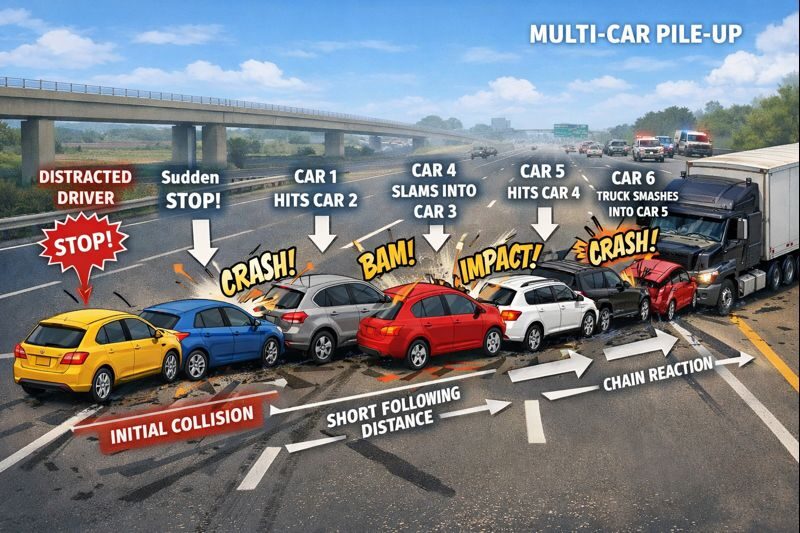
Multi-vehicle collisions are among the most chaotic and complex events on the road. According to the National Highway Traffic Safety Administration (NHTSA), accidents involving three or more vehicles account for a significant number of traffic-related injuries and fatalities each year. Unlike a simple two-car incident where fault may be straightforward, a pile-up involves a tangled web of impacts and actions. The initial crash can trigger a rapid series of secondary collisions, making it difficult for those involved, and even law enforcement, to immediately piece together the sequence of events.
The process of determining legal responsibility in these situations hinges on the legal principle of negligence. Every driver has a duty to operate their vehicle with reasonable care to avoid harming others. A breach of this duty, such as speeding, tailgating, or distracted driving, constitutes negligence. In a multi-car accident, investigators, insurance companies, and legal professionals must analyze the actions of every driver to see who breached their duty of care and how that breach contributed to the pile-up. This analysis is further complicated by differing state laws, which set the rules for how fault is shared and how compensation is awarded.
The Initial Impact: Unraveling the First Collision
The starting point for any multi-car accident investigation is the first point of contact. Identifying the driver or drivers responsible for the initial collision is fundamental, as their actions set the entire chain of events in motion. This first impact creates a sudden and unavoidable hazard for all subsequent vehicles. While it may seem simple, pinpointing this trigger event requires a careful look at the evidence, as the first car to be hit is not always blameless.
The Sudden Stop Scenario
In many cases, the lead vehicle in a pile-up is struck from behind after slowing or stopping. However, the driver of this lead vehicle can be found partially or even fully at fault under certain circumstances. For example, if a driver “brake checks” another vehicle by slamming on their brakes intentionally and without cause, they have created a dangerous situation and breached their duty of care. Other examples of lead-driver negligence include:
- Stopping suddenly in a lane of traffic to make an illegal turn.
- Driving with broken or non-functioning brake lights, failing to warn following drivers of a slowdown.
- Pulling out into traffic without enough space, forcing other cars to brake abruptly.
- Experiencing a mechanical failure that could have been prevented with proper vehicle maintenance.
In these situations, while the following driver still has a duty to maintain a safe distance, the lead driver’s negligent act is a primary contributing factor to the collision.
The First Rear-End Collision
More commonly, the driver who initiates the pile-up is the one who first strikes a stopped or slowing vehicle from behind. There is a general legal presumption that a driver who rear-ends another vehicle is at fault. This is based on the rule that every driver must maintain a safe following distance to allow for enough time and space to stop if the vehicle ahead brakes suddenly. This distance should increase with speed and in poor weather conditions.
A driver who fails to do so and causes the first impact in a pile-up will likely bear a significant portion of the liability. Their inability to stop safely directly caused the initial hazard that led to the subsequent chain reaction. Insurance adjusters and courts will look for evidence of tailgating, speeding, or distracted driving, such as cell phone records, to establish this initial breach of duty.
Chain Reaction Collisions: Following the Domino Effect
Once the first impact occurs, a chain reaction is often set in motion, where one car is pushed into the next, creating a domino-like effect. This is one of the most common types of multi-car pile-ups, and assigning fault requires understanding the physics of the impacts. The key question investigators ask is whether there was one continuous push from the back or a series of separate, individual impacts.
The Last Driver’s Responsibility
In a classic chain reaction where Car 3 hits Car 2 and pushes it into Car 1, the driver of the last vehicle (Car 3) is often found to be the primary at-fault party. The logic is that if this last driver had maintained a safe distance and stopped in time, they would not have struck Car 2, and the forward push into Car 1 would never have happened. The force from their single impact is responsible for the damage to all the vehicles ahead.
Scenario Example: Imagine four cars (Car 1, Car 2, Car 3, and Car 4) are stopped in traffic. Driver 4 is distracted and crashes into the back of Car 3. The force of this collision propels Car 3 into Car 2, which in turn is pushed into Car 1. In this scenario, Driver 4 would likely be held 100% liable for the damages to all three other vehicles because their single negligent act caused the entire sequence.
Fault in the Middle
Liability becomes more complicated when a middle driver is also negligent. A driver in the middle of the pile-up can share fault if they failed to leave enough space between their vehicle and the one in front of them. For instance, if Car 3 rear-ends Car 2, and then Car 4 rear-ends Car 3, there are two separate impacts.
Consider this variation: Car 2 stops suddenly. Car 3, following too closely, hits Car 2. A moment later, Car 4, also following too closely, hits Car 3. In this case, Driver 3 is at fault for the damage to Car 2, and Driver 4 is at fault for the damage to Car 3. This is not a pure “push-through” chain reaction but a series of individual rear-end collisions. Determining this often comes down to witness statements, especially from the drivers themselves. A key piece of information is whether a driver felt one impact from behind or two separate impacts (one from behind and one from their car hitting the vehicle in front).
How State Negligence Laws Dictate Liability
Understanding who is at fault is only part of the equation. How that fault translates into financial responsibility is determined by state-specific negligence laws. These laws govern how, and if, an injured person can recover damages if they are found to be partially responsible for the accident. This is especially important in multi-car pile-ups, where it is common for more than one driver to be assigned a percentage of blame.
At-Fault vs. No-Fault States
First, it’s important to distinguish between “at-fault” and “no-fault” insurance systems. In an at-fault state, the driver who caused the accident is responsible for paying for the damages through their liability insurance. In a no-fault state, each driver’s own insurance policy (specifically, their Personal Injury Protection or PIP coverage) pays for their initial medical expenses, regardless of who caused the crash. However, no-fault rules typically only apply to injuries, not property damage. Furthermore, if injuries are severe and meet a certain threshold, the injured party can still step outside the no-fault system and sue the at-fault driver.
Pure Comparative Negligence
Several states, including California, Florida, and New York, follow a “pure comparative negligence” rule. Under this system, an injured person can recover damages even if they were 99% at fault for the accident. However, their compensation will be reduced by their percentage of fault. For example, if you are awarded $100,000 in damages but are found to be 30% at fault for the pile-up, you will only receive $70,000.
Modified Comparative Negligence
The majority of states use a “modified comparative negligence” system. This rule is similar to the pure version, but with a critical cutoff point.
- 51% Bar Rule: In states like Texas and Georgia, you cannot recover any damages if you are found to be 51% or more at fault for the accident.
- 50% Bar Rule: In other states like Colorado and Arkansas, you are barred from recovery if you are 50% or more at fault.
This makes the percentage of fault assigned by an insurance adjuster or jury extremely important. Being found 49% at fault means you can recover 51% of your damages, but being found 51% at fault means you get nothing.
Contributory Negligence
A small handful of jurisdictions, including Virginia, Maryland, and North Carolina, adhere to the harsh rule of “contributory negligence.” Under this doctrine, if you are found to be even 1% at fault for the accident, you are completely barred from recovering any compensation from the other at-fault parties. This unforgiving standard makes it essential for anyone in a multi-car accident in these states to avoid any admission of fault and seek legal counsel immediately.
Gathering Crucial Evidence at the Scene and Beyond
Because determining fault in a pile-up is so complex, the evidence collected at the scene and in the days following is what builds the foundation for any car insurance claim or lawsuit. Without strong evidence, assigning liability becomes a matter of one driver’s word against another’s. A clear and comprehensive collection of facts is the best tool for protecting your rights.
The Role of the Police Report
The official police report is one of the most influential documents in a multi-car accident case. When law enforcement arrives, they will assess the scene, speak with drivers and witnesses, and document their initial findings. The report typically includes:
- A diagram of the accident scene, showing the final resting positions of the vehicles.
- The officer’s narrative of how they believe the accident occurred.
- Any traffic citations issued to drivers for violations like speeding or following too closely.
- Contact information for all drivers and witnesses.
- Statements made by the parties involved.
While the officer’s opinion on fault is not legally binding, it carries significant weight with insurance adjusters. Obtaining a copy of this report is a critical first step.
Witness Statements and Your Own Account
Independent witnesses who have no stake in the outcome are invaluable. Their testimony can corroborate your version of events and provide an unbiased perspective on the sequence of impacts, the speed of vehicles, or the behavior of other drivers. If you are able, get the names and phone numbers of any witnesses before they leave the scene.
Equally important is to document your own recollection as soon as possible. The details of a traumatic event can fade quickly. Write down everything you remember: the weather, traffic conditions, what you were doing right before the crash, the number of impacts you felt, and anything you heard other drivers say. This personal account will be essential when speaking with your insurer or attorney.
Physical Evidence: Photos, Videos, and Vehicle Damage
Physical evidence is objective and powerful. If you are not seriously injured, use your smartphone to take extensive photos and videos of the scene from multiple angles. Be sure to capture:
- The damage to all vehicles involved, both up close and from a distance.
- The license plates of every car.
- Skid marks on the pavement.
- Debris fields from the collisions.
- Road signs, traffic signals, and overall road conditions.
The location and type of damage on the vehicles can tell a story. For example, a car with damage to both its front and rear bumpers is a classic sign of a middle car in a chain reaction. Dashcam footage, if available from your vehicle or another witness, can be the single most decisive piece of evidence, providing a clear, indisputable record of the event.
The Insurance Investigation: How Adjusters Determine Fault
After a claim is filed, each driver’s insurance company will launch its own investigation to determine liability. Insurance adjusters are trained to protect their company’s financial interests, which means their goal is often to minimize their own driver’s fault and, consequently, the amount the company has to pay out. They will use the evidence gathered to piece together their own version of the accident.
Recorded Statements: A Potential Pitfall
An adjuster from another driver’s insurance company will likely call you and ask for a recorded statement. It is highly advisable to be cautious. These insurance adjusters are skilled at asking questions designed to elicit responses that can be interpreted as an admission of fault. A simple apology or an uncertain answer about your speed could be used against you later to assign you a percentage of the blame. You are not legally obligated to provide a statement to another driver’s insurer. It is often best to decline until you have spoken with your own insurance company or a personal injury attorney.
Accident Reconstruction Experts
In high-stakes cases involving serious injuries or conflicting accounts, insurance companies or attorneys may hire an accident reconstruction expert. These are typically former law enforcement officers or engineers with specialized training. They use a scientific approach to analyze the physical evidence, including:
- “Black box” data (Event Data Recorder) from the vehicles, which records speed, braking, and steering inputs just before a crash.
- The crush damage on the vehicles to calculate impact speeds and angles.
- Skid mark analysis and roadway evidence.
Their findings can create a highly detailed, computer-animated recreation of the pile-up, providing a clear and persuasive explanation of how the collision sequence unfolded and who was responsible.
Assigning Percentages of Fault
Ultimately, the adjuster will review all the evidence: the police report, statements, photos, and expert analysis and make a liability determination. In a multi-car pile-up, this often involves assigning a percentage of fault to multiple drivers. For example, they might find the last driver in a chain reaction 80% at fault for causing the primary impact, but find a middle driver 20% at fault for following too closely, thereby contributing to the severity of their own damages. This assignment of percentages directly impacts how much compensation can be recovered, based on the state’s negligence laws.
Common Scenarios and Who Is at Fault in a Multi-Car Pile-Up
While every accident is unique, many multi-car pile-ups fall into recognizable patterns. Understanding these common scenarios can help clarify how liability is typically assessed.
Scenario 1: The Highway Slowdown Pile-Up
This often occurs in heavy, fast-moving traffic. The lead car brakes for a sudden traffic jam. The second car stops safely, but the third car does not and rear-ends the second car, pushing it into the first. The fourth car then rear-ends the third. In this case, liability is likely shared. The driver of the third car is at fault for hitting the second, and the driver of the fourth car is at fault for hitting the third. Each driver failed to maintain a safe following distance for the highway speeds.
Scenario 2: The Unsafe Lane-Change Pile-Up
A driver attempts to change lanes without checking their blind spot or using a signal. They cut off another vehicle, forcing that driver to slam on their brakes. While the second driver avoids hitting the lane-changing car, the car behind them is unable to stop in time and rear-ends them, triggering a pile-up. Here, the driver who made the unsafe lane change is the primary cause of the accident, even if their vehicle was never actually struck. Their negligent action created the hazard that led directly to the collisions.
Scenario 3: The Bad Weather Pile-Up
Pile-ups are common in fog, heavy rain, snow, or icy conditions. While drivers may be tempted to blame the weather, the law holds that every driver has a duty to adjust their driving to the current conditions. This means slowing down, increasing following distance, and using extra caution. A driver who causes a collision by driving too fast for the conditions will be found negligent. In a bad weather pile-up, it is common for multiple drivers to be found partially at fault for failing to adapt their driving appropriately.
Why Legal Representation is Essential in Complex Collisions
When multiple vehicles and insurance companies are involved, protecting your interests can become a monumental task. The competing goals of different insurers can create a confusing and contentious environment where your claim could be unfairly denied or minimized. Securing representation from an experienced personal injury attorney is often the most effective way to ensure a fair outcome.
Dealing with Multiple Insurance Companies
A multi-car pile-up means you may have to deal with claims adjusters from several different insurance carriers. Each one will be working to shift blame away from their own client. An Atlanta car accident attorney can handle all communications on your behalf, preventing you from making any statements that could hurt your case. They will manage the flow of information and present a unified, evidence-based argument to all parties involved, streamlining a process that would otherwise be chaotic.
Proving Your Case and Maximizing Recovery
A skilled attorney knows precisely what evidence is needed to build a strong case. They can launch their own investigation, subpoena cell phone records, hire accident reconstruction experts, and depose witnesses to establish a clear picture of liability. They will also ensure that all of your damages including medical bills, lost wages, future medical needs, and pain and suffering, are properly documented and claimed. Their expertise is crucial in fighting back against any attempts to unfairly assign you partial fault, especially in states with modified or contributory negligence rules.
Navigating Complex Legal Doctrines
The legal doctrines of comparative and contributory negligence are not intuitive. An Atlanta personal injury attorney understands the specific laws in your state and how they apply to the facts of your case. They can advocate on your behalf to ensure that any percentage of fault assigned to you is as low as possible, or eliminated entirely, to maximize the compensation you are entitled to receive. This legal guidance is critical in preventing a minor misstep from costing you your entire claim.
Conclusion
Determining who is at fault in a multi-car pile-up is a detailed process that moves far beyond simple assumptions. Liability is rooted in the principle of negligence, and investigators must carefully analyze the actions of every driver to understand who breached their duty of care. The initial impact, the sequence of subsequent collisions, and the physical evidence all play a role in this determination. The outcome is ultimately shaped by state-specific negligence laws that dictate how shared fault affects a person’s ability to recover damages.
Given the complexity of these cases and the financial stakes involved, taking decisive action is crucial. The moments after a pile-up are critical for gathering evidence, and the days that follow are filled with procedural steps that can impact your claim. Do not leave your financial and physical recovery to chance. Consulting with a qualified personal injury attorney who specializes in complex traffic accidents is the most reliable way to protect your rights, establish a clear case for liability, and secure the full compensation you deserve. The statute of limitations for filing a claim is finite, so seeking professional legal advice promptly is essential. Contact us today for free case evaluation.