
Home Insurance Claim Adjuster Secret Tactics Homeowners Should Know
Posted by Wetherington Law Firm | Articles
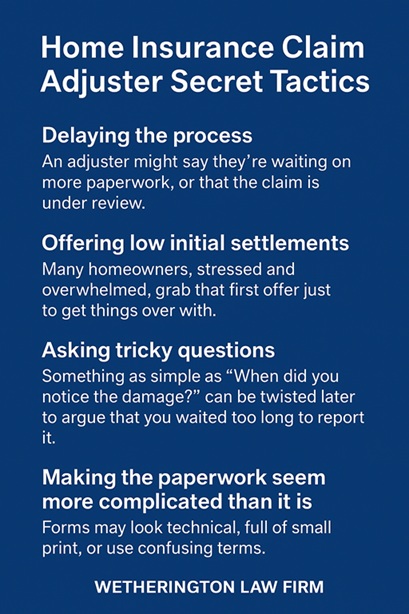
TL;DR: Insurance adjusters are trained to protect the company’s financial interests, which often means minimizing your claim payout. They employ specific tactics such as offering a quick but low settlement before you know the full extent of the damage, using your recorded statement to find inconsistencies, and intentionally downplaying the scope of necessary repairs. To counter these strategies, never accept the first offer, be cautious with recorded statements, and always get independent estimates from contractors you trust.
Key Highlights
- Lowball First Offers: Adjusters often make a fast settlement offer, hoping you’ll accept it out of convenience before hidden damages are discovered.
- Recorded Statement Traps: They use recorded statements to get you to say things that can be used to question the validity or value of your claim.
- Minimizing Repair Scope: They will try to pay for patching instead of replacing, ignore building code requirements, and dispute the need for matching materials.
- Strategic Delays: By slowing down the process, they create frustration, making you more likely to accept an unfair settlement just to move on.
- “Preferred Contractor” Pressure: They steer you toward their network of contractors who may prioritize the insurer’s budget over the quality of your repairs.
Each year, about one in twenty insured homes in the United States experiences a property damage claim, ranging from wind and hail damage to more severe fire and water incidents. This results in billions of dollars paid out by insurance carriers. Behind every one of these claims is an insurance adjuster, a professional tasked with investigating the loss, interpreting the policy, and determining the value of the damage. Their role is a fundamental part of the insurance process, acting as the primary point of contact between the homeowner and the massive corporate entity.
The relationship between an adjuster and a policyholder is complex. While they are there to facilitate your claim, their ultimate professional duty is to their employer: the insurance company. They operate under a set of performance metrics that often prioritize closing files quickly and for the lowest possible amount that can be justified. This is guided by the legal principle of “good faith and fair dealing,” which requires insurers to treat policyholders fairly. However, the interpretation of what is “fair” can become a major point of contention, as the adjuster’s goals are inherently in conflict with the homeowner’s goal of being made whole.
1. The Quick Settlement Trap: Why Their First Offer is Rarely Their Best
One of the most common tactics an insurance adjuster will use is to present you with a quick settlement offer. This often happens within days of the incident, sometimes even during their first visit to your property. The adjuster will seem helpful and empathetic, explaining that this check will help you get started on repairs right away. For a homeowner dealing with the stress of a damaged home, this can feel like a lifeline.
The reality is that this speed is a strategy. The insurance company knows that the longer a claim is open, the more likely it is that you will discover additional, hidden damage. Water that seeps behind a wall can lead to mold. Smoke from a small kitchen fire can permeate an entire HVAC system. A roof leak might have caused structural rot that isn’t immediately visible. A quick offer is calculated to close the claim before these secondary problems surface, saving the insurance company a significant amount of money.
This initial offer is typically based on a superficial inspection and pricing generated by software like Xactimate. While this software is an industry standard, its output is only as good as the data entered. An adjuster looking to minimize a payout can easily omit line items, use lower-grade material costs, or underestimate the labor required. They are banking on the fact that you, the homeowner, don’t have the expertise to spot these omissions.
The “Sign Here and It’s Over” Release Form
Accompanying that first check will be a document, often called a “Proof of Loss” or a “Settlement and Release” form. By signing it, you are agreeing that the payment represents a full and final settlement for your claim. Once you sign and cash that check, you generally lose the right to request more money, even if your contractor discovers thousands of dollars in hidden damage a week later. The adjuster will not highlight this fact; they will present it as a standard piece of paperwork needed to release your funds.
Actionable Steps to Avoid This Trap:
- Never Accept the First Offer: Politely thank the adjuster for the offer and inform them that you will need time to review it and get your own estimates.
- Hire an Independent Contractor: Get at least two or three detailed, itemized estimates from reputable local contractors who work for you, not the insurance company.
- Compare Estimates Line-by-Line: Sit down with the adjuster’s estimate (often called a “scope of loss”) and your contractor’s estimate. Look for discrepancies in materials, labor rates, and the scope of work.
- Do Not Sign a Final Release Prematurely: Do not sign any document that releases the insurance company from future liability until you are 100% certain that all damages have been identified and accurately priced.
2. Mastering the Recorded Statement: How Your Own Words Are Used Against You
Shortly after you file a claim, the adjuster will likely ask you to provide a recorded statement. They will frame this as a routine step, a simple formality to “get your side of the story” and document the facts of the loss. This request sounds reasonable, but it is a critical strategic move designed to protect the insurer’s interests. The adjuster is not a friendly ear; they are a trained investigator looking for information that can be used to limit or deny your claim.
During the statement, the adjuster will ask a series of carefully crafted questions. They listen for inconsistencies, admissions of fault, or any speculation on your part. Your words can be taken out of context and used against you later in the claims process.
Here are examples of seemingly innocent questions and the traps they contain:
- “How old was your roof before the storm?” If you say it was old or had some wear, they may argue the damage was due to age and poor maintenance, not the covered peril (like wind or hail).
- “Did you notice any small leaks or water spots before this happened?” Answering “yes” could give them grounds to claim the problem was a pre-existing condition that you failed to mitigate, voiding coverage.
- “So, in your opinion, what caused the pipe to burst?” This invites you to speculate. If you guess wrong, they can use your own opinion against the findings of an expert you may hire later.
The Dangers of Speculation
The most significant risk in a recorded statement is being pressured into guessing. When you are unsure about a timeline, a specific detail, or the cause of an event, it is human nature to try to be helpful and provide an answer. However, any speculation can damage your claim. If you say the fire “might have started” from an old appliance, they will focus their entire investigation on that possibility, potentially ignoring other causes that would be more clearly covered.
Actionable Steps for Handling Recorded Statements:
- Know Your Rights: In most situations, you are not legally obligated to provide a recorded statement immediately. You can request to schedule it for a later time, giving you a chance to prepare. Review your policy, as some may contain a “duty to cooperate” clause that requires it.
- Keep Answers Short and Factual: Do not volunteer extra information. Answer only the question that was asked. If the question is “When did you first notice the water?” the answer is the date and time, not a long story about your week.
- It’s Okay to Say “I Don’t Know”: If you are unsure about a fact, the correct answer is “I don’t know” or “I don’t recall at this moment.” This is far better than guessing.
- Consult a Professional First: Before giving a statement for a large or complex claim, it is wise to speak with a public adjuster or an attorney. They can advise you on how to answer questions truthfully without jeopardizing your claim.
4. The Art of Disputing Damage: Minimizing the Scope and Cost of Repairs
The core of any property damage claim is the “scope of work,” which is the detailed list of repairs needed to return your home to its pre-loss condition. This is where the biggest battles are often fought. An adjuster’s primary method for reducing a claim’s value is to aggressively minimize this scope. They will argue that certain damages are not related to the covered event, that cheaper repair methods are sufficient, or that certain items do not need to be replaced.
This tactic manifests in several ways. The adjuster may create an estimate that only accounts for the most obvious damage, ignoring the less visible but equally important issues. They are trained to see a claim in terms of individual components rather than as a whole system, which allows them to justify piecemeal repairs that may not fully restore your property’s value or function.
“Matching” Issues and Line of Sight
A very common dispute involves matching materials. Imagine a hailstorm damages one side of your roof or a kitchen leak ruins half of your hardwood floor. The adjuster may offer to pay only to replace the damaged shingles or floorboards. The problem is that the new materials will not match the existing ones due to age, sun-fading, or discontinued product lines. This leaves you with a visually inconsistent, patched-up home, which can significantly lower its resale value.
While you may argue that the entire roof or floor needs to be replaced to restore “uniform appearance,” the adjuster will counter that the policy only covers “direct physical damage.” Some states have specific laws or regulations regarding matching, but adjusters will often ignore them unless challenged.
Hidden Damage and Code Upgrades
Initial inspections, especially those done quickly, often miss underlying problems. An adjuster’s estimate for drywall repair might not include the cost of treating potential mold growth behind it. An estimate for a new roof might omit the cost of replacing the decking underneath, which may have been damaged by water.
Furthermore, when you perform major repairs, you are often required by local building codes to upgrade other parts of your home. For example, a roof replacement might trigger a requirement to install new ventilation systems. Many insurance policies contain coverage for these “code upgrades,” but adjusters will rarely offer to pay for them voluntarily. You must know your policy and demand the coverage you are entitled to.
Actionable Steps for Defining the Scope:
- Document Everything: Before any cleanup or demolition, take hundreds of photos and videos of the damage from every angle.
- Get Your Own Scope of Work: Hire a trusted contractor to prepare a highly detailed, itemized scope of work that includes everything needed to properly repair your home.
- Challenge a Low Scope: If the adjuster’s scope is missing items, provide them with your contractor’s estimate and demand a written explanation for each discrepancy.
- Cite Your Policy and Local Codes: If the adjuster refuses to pay for code upgrades or matching, ask them to provide the specific policy language they are using to justify their position. Research your local building codes to support your case.
5. Delay, Deny, Defend: The Strategy of Exhaustion
Sometimes, an insurance company’s most effective tactic is inaction. By intentionally dragging out the claims process, they put immense financial and emotional pressure on the policyholder. This strategy, known in the industry as “delay, deny, defend,” is designed to wear you down until you are so frustrated that you will accept any settlement just to be done with the ordeal.
The delays can come in many forms:
- Slow Communication: The adjuster may take days or even weeks to return your phone calls and emails.
- Excessive Paperwork Requests: They might repeatedly ask for the same documents you have already sent or request obscure information that is difficult to obtain.
- Switching Adjusters: Your claim might be passed from one adjuster to another, forcing you to restart the process and explain the situation all over again.
- Prolonged “Investigation”: They may claim your loss is “under investigation” for an indefinite period without providing a clear reason or timeline.
This is a war of attrition. The insurance company has vast resources and is in no hurry. You, on the other hand, may be displaced from your home, paying for temporary housing, and watching your repair costs rise. The insurer knows that this pressure makes you more likely to abandon a legitimate dispute and accept their low offer.
Understanding Your Policy’s Deadlines
While the insurance company is delaying, it’s crucial to remember that you have your own deadlines to meet under the policy. Most policies require you to submit a sworn “Proof of Loss” form within a specific timeframe (e.g., 60 days) after they request it. If you miss this deadline because you are waiting for the adjuster to get back to you, the company could use it as a reason to deny your entire claim. They can use their own delays to cause you to miss your contractual obligations.
Actionable Steps to Combat Delays:
- Communicate in Writing: After any phone call with the adjuster, send a follow-up email summarizing the conversation, including any agreements made and the expected timeline for their next action. This creates a paper trail.
- Send Documents via Certified Mail: For critical documents like a Proof of Loss form, send them via certified mail with a return receipt requested. This proves they received it and when.
- Set Your Own Deadlines: In your written communications, state your expectations clearly. For example, “I am awaiting your response to the contractor’s estimate we sent on [Date]. Please provide your position on this by [Date].”
- Invoke “Bad Faith”: If the delays become unreasonable and you believe the insurer is not acting in good faith, you can send a formal letter stating this. The term “bad faith” is a legal concept that can get the attention of a supervisor.
- File a Complaint: If the delays persist, file a formal complaint with your state’s Department of Insurance. This will trigger an official inquiry and often prompts the insurer to act.
6. The “Preferred Contractor” Network: Whose Interest Do They Really Serve?
When you report a loss, the adjuster will often offer to send one of their “preferred” or “managed repair program” contractors to your home. They will present this as a benefit to you, a way to simplify the process with a pre-screened, qualified professional. They may even suggest that using their contractor will speed up the claim and that the work will come with a warranty from the insurance company.
While this may sound convenient, you must question whose interests this contractor truly serves. These contractors get a massive volume of business from the insurance company. Their primary relationship is with the insurer, not with you. To remain in the preferred network and continue receiving referrals, they have a powerful incentive to keep repair costs low and align their scope of work with what the adjuster wants to pay.
This can lead to several problems:
- Cutting Corners: They may use lower-quality materials or less-skilled labor to meet the insurer’s budget.
- Incomplete Repairs: They might perform only the repairs explicitly approved by the adjuster, ignoring other related damages they find.
- Lack of Advocacy: A truly independent contractor will fight on your behalf to ensure the insurance company pays for a proper and complete repair. A preferred contractor is unlikely to challenge the adjuster who is sending them dozens of jobs a year.
The Illusion of a Warranty
The warranty offered by the insurance company for using their preferred contractor is often used as a key selling point. However, this can be a double-edged sword. If you have a problem with the repairs, you must go through the insurance company’s program to get it fixed, which can be a slow and frustrating process. It also keeps you tied to their network, limiting your control over your own home. A reputable independent contractor will provide their own workmanship warranty, giving you a direct line of recourse.
Actionable Steps Regarding Contractors:
- Assert Your Right to Choose: You have the absolute right to hire any licensed and insured contractor you want. Do not let the adjuster pressure you into using their recommendation.
- Vet Your Own Contractors: Get at least three detailed bids from well-regarded, local contractors. Check their licenses, insurance, and online reviews. Ask for references from recent jobs.
- Ensure Your Contractor Works for You: Have a frank discussion with your chosen contractor. Make it clear that you expect them to be your advocate and to document all necessary repairs, not just what the insurance company initially offers to pay.
- Control the Payment: Never let the insurance company pay the contractor directly. The payment should be made to you, and you should only pay the contractor once you are completely satisfied with the work.
7. Misinterpreting Your Policy: Using Complex Language to Limit Coverage
Your home insurance policy is a dense, complicated legal contract filled with jargon, exclusions, endorsements, and conditions. Adjusters are highly trained in interpreting this language to the company’s advantage. They know that the average homeowner has never read their policy in full and will not understand the fine print. This knowledge gap is a powerful tool they can use to wrongly limit or deny coverage.
An adjuster might tell you that a certain type of damage is not covered by citing a specific exclusion in the policy. However, they may fail to mention an exception to that exclusion or a separate endorsement you purchased that actually provides the coverage.
Exclusions, Endorsements, and Ambiguities
For example, an adjuster might deny a claim for water damage from a backed-up sewer line by pointing to the standard “water damage exclusion” found in most policies. What they might not tell you is that you paid extra for a “Sewer and Drain Backup Endorsement,” which specifically adds this coverage back into your policy. They are counting on you not knowing the details of your own coverage.
Ambiguities in the policy language are another area of contention. In most legal jurisdictions, if a term in a contract is ambiguous, it is supposed to be interpreted in favor of the party that did not write the contract, which is you, the policyholder. Adjusters will almost always interpret ambiguous language in the way that most benefits the insurance company.
The Depreciation Game
One of the most complex parts of a claim is how depreciation is calculated. Most policies provide for Replacement Cost Value (RCV), but the initial payment is often for Actual Cash Value (ACV).
- Actual Cash Value (ACV): The cost to replace an item minus depreciation for its age and condition.
- Replacement Cost Value (RCV): The full cost to replace the item with a new, similar item.
The adjuster will first pay you the ACV. You can then claim the withheld depreciation (the difference between RCV and ACV) after you have completed the repairs. However, adjusters can manipulate this process by applying excessive depreciation to your property, reducing your initial payment and putting a greater financial burden on you to front the repair costs. They may also try to depreciate items that should not be, such as labor or debris removal, which is improper in most states.
Actionable Steps to Understand Your Coverage:
- Request a Certified Copy of Your Policy: Don’t rely on the declarations page or a summary. Get a complete copy of your policy, including all forms and endorsements.
- Read the Relevant Sections: Focus on the “Coverages,” “Exclusions,” and “Conditions” sections related to your specific type of loss.
- Demand Written Explanations: If an adjuster denies part of your claim based on policy language, require them to send you a formal denial letter that quotes the exact wording they are relying on.
- Challenge Depreciation Calculations: Ask the adjuster for a detailed breakdown of how they calculated depreciation for each item. If it seems excessive, provide evidence of your property’s good condition before the loss.
Taking Control of Your Home Insurance Claim
The tactics used by insurance claim adjusters are designed to control the process and the payout, all to the benefit of the company’s bottom line. From the initial quick offer to the complex interpretation of policy language, every step is a potential pitfall for an unprepared homeowner. Recognizing these strategies is your most powerful defense. By understanding that the adjuster’s first offer is a starting point for negotiation, that your words in a recorded statement carry immense weight, and that you have the right to your own independent experts, you can begin to level the playing field.
Your home is your most valuable asset, and the insurance policy you pay for is a promise to restore it after a disaster. It is your responsibility to hold the insurance company to that promise. This means being a proactive, organized, and assertive advocate for your own claim. Document everything, communicate in writing, and never be afraid to challenge a decision that seems unfair. The initial days and weeks following a property loss are critical; the actions you take during this time will directly impact the final outcome of your settlement.
If your claim is substantial, complex, or you feel the adjuster is not treating you fairly, do not hesitate to seek professional help. A qualified public adjuster or an experienced insurance claim attorney works for you, not the insurance company. They understand these tactics intimately and can manage the entire process on your behalf, ensuring you receive the full and proper settlement you are entitled to under your policy. You do not have to face this process alone.
If you’re facing delays, lowball offers, or pressure from an insurance adjuster, don’t navigate the process alone. Speak with an experienced attorney or public adjuster who can help you protect your claim and fight for the full payout you deserve. Contact us for a free case evaluation.